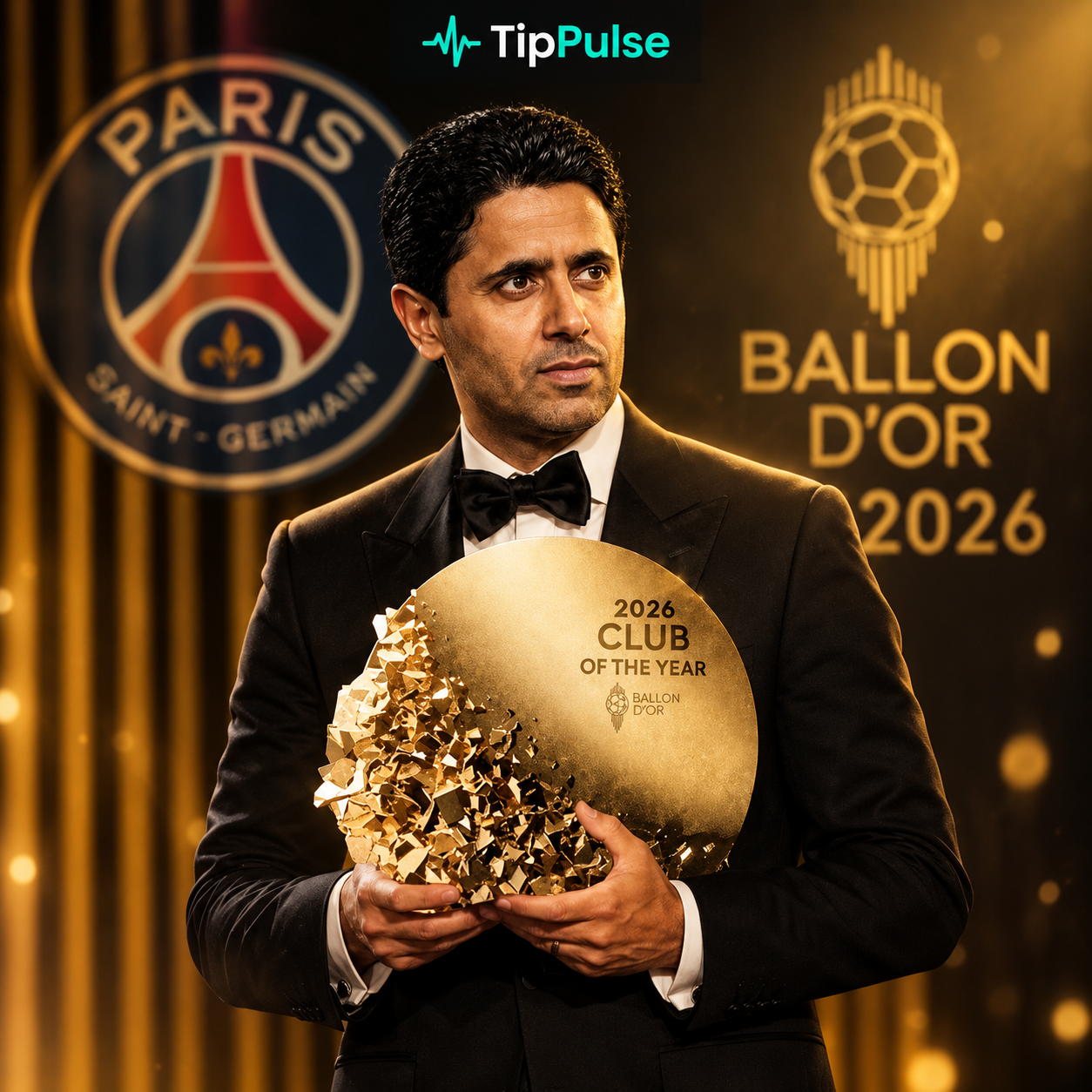
Paris Saint-Germain have officially been named the best men’s club in world football for the second consecutive year — and the numbers explain why.
PSG won the 2026 Ballon d’Or Men’s Club of the Year award after another extraordinary campaign featuring five trophies, a second consecutive Champions League title and a level of collective consistency few teams in Europe could match.
But the most impressive part of PSG’s season was not simply the silverware.
Luis Enrique has built a team where responsibility is spread across almost every area of the pitch. Goals come from different players, full-backs become attackers, midfielders control possession, defenders allow the team to play aggressively and even when one star is unavailable, the overall structure remains intact.
Five Trophies in One Award Period
PSG’s Club of the Year victory was built on one of the most successful periods in the club’s history.
The Parisians collected five major trophies during the Ballon d’Or evaluation period:
- UEFA Champions League
- Ligue 1
- UEFA Super Cup
- FIFA Intercontinental Cup
- Trophée des Champions
The biggest achievement was retaining the Champions League.
PSG defeated Arsenal on penalties in the final after a 1-1 draw, becoming only the second club in the Champions League era to successfully defend the trophy after Real Madrid.
That alone separated them from almost every other major European club.
The Champions League Numbers
PSG did not defend their European title by playing cautious knockout football.
They finished the Champions League campaign with 45 goals, more than any other team in the competition.
They also averaged approximately 61% possession, the highest figure in the tournament, while completing their passes at 89.5% accuracy.
Those numbers perfectly describe Luis Enrique’s football: control the ball, move opponents constantly and then attack aggressively once spaces appear.
The knockout results were particularly impressive.
PSG eliminated Chelsea 8-2 on aggregate in the round of 16, destroyed Liverpool 4-0 across the quarter-finals and survived a spectacular 6-5 semi-final against Bayern Munich before beating Arsenal in the final.
They were capable of dominating technically, but also showed they could survive chaotic games and high-pressure moments.
Why PSG’s Team Chemistry Was So Important
The biggest reason PSG became so difficult to stop was that the team no longer depended on one superstar.
In previous eras, Paris were often built around individual brilliance. This version is different.
Marquinhos and Willian Pacho provided the defensive platform, allowing Achraf Hakimi and Nuno Mendes to move forward almost like additional midfielders or wingers.
Vitinha and João Neves controlled the rhythm in midfield, constantly offering passing options and helping PSG recover possession quickly after losing the ball.
Ahead of them, Ousmane Dembélé, Khvicha Kvaratskhelia, Désiré Doué and Bradley Barcola could rotate positions rather than remaining fixed to one area.
That movement made PSG unpredictable.
An opponent could stop one player, but that did not stop the system.
The Stats Show How Collective PSG Were
The individual numbers reinforce that point.
Khvicha Kvaratskhelia finished as PSG’s Champions League top scorer with 10 goals.
But creativity was shared. Kvaratskhelia and Achraf Hakimi both recorded six Champions League assists.
Vitinha covered an extraordinary 190.8 kilometres during the European campaign, underlining how important his movement and positioning were to PSG’s midfield control.
Willian Pacho played 1,560 Champions League minutes, more than any other PSG player, providing consistency at the back throughout the campaign.
Perhaps the clearest evidence of PSG’s collective quality came at the Ballon d’Or ceremony itself.
Ten PSG players were included among the 30 Ballon d’Or nominees — a record for a single club.
Kvaratskhelia, Dembélé, Fabián Ruiz, Hakimi, Vitinha, Ferran Torres, João Neves, Pacho, Nuno Mendes and Marquinhos all made the shortlist.
That is not the profile of a team carried by one player.
Domestic Dominance Was Just as Impressive
PSG also won their fifth consecutive Ligue 1 title, something the club had never previously achieved.
With one match still remaining when the title was secured, PSG had scored 73 league goals — the best attacking record in France.
More impressively, those goals had been shared between 18 different players.
That number perfectly captures the philosophy behind Luis Enrique’s side.
The responsibility to score does not belong exclusively to the centre-forward. Wingers, midfielders, full-backs and substitutes all contribute.
PSG also had the league’s strongest defensive record by clean sheets, recording 17 shutouts during the title-winning campaign.
Luis Enrique Changed the Identity of PSG
This may ultimately be the biggest reason the award feels deserved.
PSG have always possessed expensive and technically gifted players. What changed under Luis Enrique was how those players functioned together.
His team presses collectively, defends with the ball and rotates positions constantly.
Hakimi can appear inside midfield. Mendes can attack almost as a winger. Dembélé can move centrally rather than remaining wide. Vitinha dictates the tempo while João Neves aggressively attacks second balls.
Those movements require trust and understanding between teammates.
And that is what makes this PSG side more dangerous than simply assembling several world-class individuals.
They Even Survived Difficult Periods
PSG’s European season was not perfect.
They finished only 11th in the Champions League league phase after four wins, two draws and two defeats.
But instead of collapsing, they improved when the tournament became more difficult.
That adaptability was another sign of maturity.
Ousmane Dembélé also missed time through injury, yet PSG continued winning because their attacking system did not disappear when one player was unavailable.
That depth became crucial across a season involving domestic football, Europe and international club competitions.
TipPulse Verdict
PSG did not win the 2026 Club of the Year award simply because they collected more trophies.
Five trophies. 45 Champions League goals. 61% European possession. 89.5% passing accuracy. 73 Ligue 1 goals from 18 different scorers. Ten Ballon d’Or nominees.
Those numbers tell the story of a complete team.
Individual quality obviously matters — PSG still possess some of the best players in world football — but their greatest strength has become coordination.
The defenders allow the full-backs to attack. The midfield protects the attackers. The forwards rotate rather than waiting for the ball. When possession is lost, the entire structure reacts together.
That may be the biggest difference between PSG’s old superstar era and the team that has now won back-to-back Champions League titles.
They are no longer simply a collection of stars.
They are a system — and in 2026, that system was judged the best club team in world football.