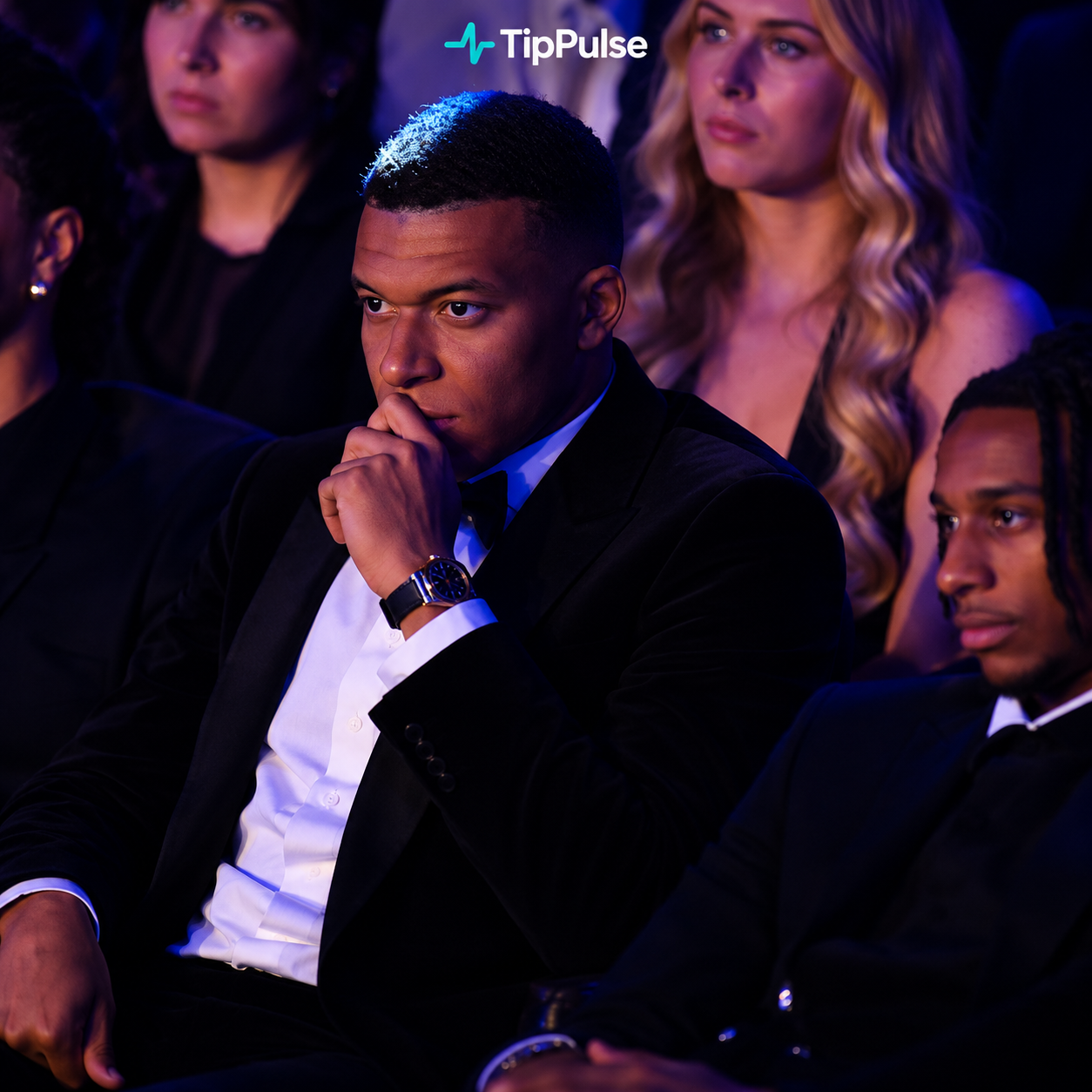
Kylian Mbappé scored 42 goals for Real Madrid, won the Pichichi Trophy, finished as the Champions League’s leading scorer and reached a World Cup semi-final — and still walked away from the 2026 Ballon d’Or ceremony without either of its two major men’s individual trophies.
Mbappé finished second in the Ballon d’Or voting behind Harry Kane, while Lamine Yamal completed the podium in third. Kane also beat the Frenchman to the Men’s Striker of the Year award.
On numbers alone, Mbappé had an extraordinary season. So why was it not enough?
Mbappé’s Numbers Were Ballon d’Or Level
There was very little wrong with Mbappé’s individual campaign.
The Real Madrid forward finished the 2025/26 season with 42 goals in 44 matches across all competitions.
He scored 25 LaLiga goals to win the Pichichi Trophy and also finished as the Champions League’s top scorer with 15 goals, one ahead of eventual Ballon d’Or winner Harry Kane.
UEFA statistics also show Mbappé recorded 30 shots on target in the Champions League, more than any other player in the competition.
Those numbers made him one of the most decisive players in European football and explain why he finished above world champion Lamine Yamal in the final Ballon d’Or ranking.
So Why Didn’t Mbappé Win?
The biggest problem was not Mbappé. It was what happened around him.
Real Madrid failed to turn his individual production into the major team trophies that usually strengthen a Ballon d’Or campaign.
Mbappé dominated the scoring charts, but Madrid did not win LaLiga or the Champions League during the award’s official reference period.
France then entered the 2026 World Cup with another opportunity to provide Mbappé with the defining team achievement his season was missing.
That opportunity disappeared in the semi-finals, where France were beaten 2-0 by eventual champions Spain.
Mbappé therefore ended the Ballon d’Or evaluation period with outstanding personal statistics but without the kind of major collective title that can separate two elite candidates.
Harry Kane Had the Stronger Overall Case
Harry Kane’s numbers were simply on another level.
The Bayern Munich striker scored 73 goals for club and country during the 2025/26 campaign, including 61 in 51 appearances for Bayern.
He finished as Bundesliga top scorer for the third consecutive season, scored 14 Champions League goals and helped Bayern retain the Bundesliga as part of a domestic treble.
Kane also scored six times at the World Cup as England reached the semi-finals.
Mbappé actually beat Kane in the Champions League Golden Boot race — 15 goals to 14 — but Kane’s overall scoring volume and Bayern’s trophies gave voters something Mbappé could not match.
What About Lamine Yamal?
Lamine Yamal represented a different kind of threat to Mbappé’s ranking.
The Barcelona winger produced 24 goals and 18 assists at club level, won LaLiga and then helped Spain become world champions.
Yamal also won the Men’s Young Talent of the Year award for a third consecutive season.
Despite those trophies, Mbappé still finished above him in the main Ballon d’Or vote. That shows just how heavily voters rated the Frenchman’s individual performances.
The final top five was:
- 1. Harry Kane — Bayern Munich and England
- 2. Kylian Mbappé — Real Madrid and France
- 3. Lamine Yamal — Barcelona and Spain
- 4. Rodri — Manchester City/Barcelona and Spain
- 5. Lionel Messi — Inter Miami and Argentina
The Ballon d’Or Rules Explain the Result
The official Ballon d’Or regulations list three voting criteria in order of importance.
The first is individual performances, decisiveness and impressive displays. On that criterion, Mbappé had one of the strongest cases in the world.
The second is collective performances and trophies won.
That is where Kane gained his advantage.
Mbappé could point to 42 Real Madrid goals, two major scoring titles and another strong international tournament. Kane could combine even greater scoring numbers with a trophy-winning Bayern campaign.
This does not mean team trophies automatically decide the Ballon d’Or — individual performance is officially the most important criterion — but when two candidates are producing extraordinary numbers, trophies can become the separator.
Did Mbappé Really Win Nothing?
Not literally.
Mbappé won the Pichichi Trophy as LaLiga’s leading scorer and finished as the Champions League’s top scorer. Real Madrid also named him their Player of the Season.
What he missed were the prizes that defined Ballon d’Or night: the main Ballon d’Or and the Men’s Striker of the Year award, both of which went to Kane.
That distinction matters. Mbappé’s season was not unsuccessful — individually it was spectacular. It simply ran into an even stronger Ballon d’Or case.
TipPulse Verdict
42 goals in 44 matches. LaLiga top scorer. Champions League top scorer. Second in the Ballon d’Or.
In most seasons, that résumé would make Mbappé the favourite.
But Harry Kane produced 73 goals for club and country while also adding major team trophies. Under the Ballon d’Or criteria, that combination proved decisive.
Mbappé did almost everything an individual player could do. What he could not control completely was Real Madrid’s trophy haul or France’s World Cup exit.
That is why 2026 may go down as one of the strangest seasons of Mbappé’s career: statistically brilliant, individually dominant — and still not enough to win the Ballon d’Or.