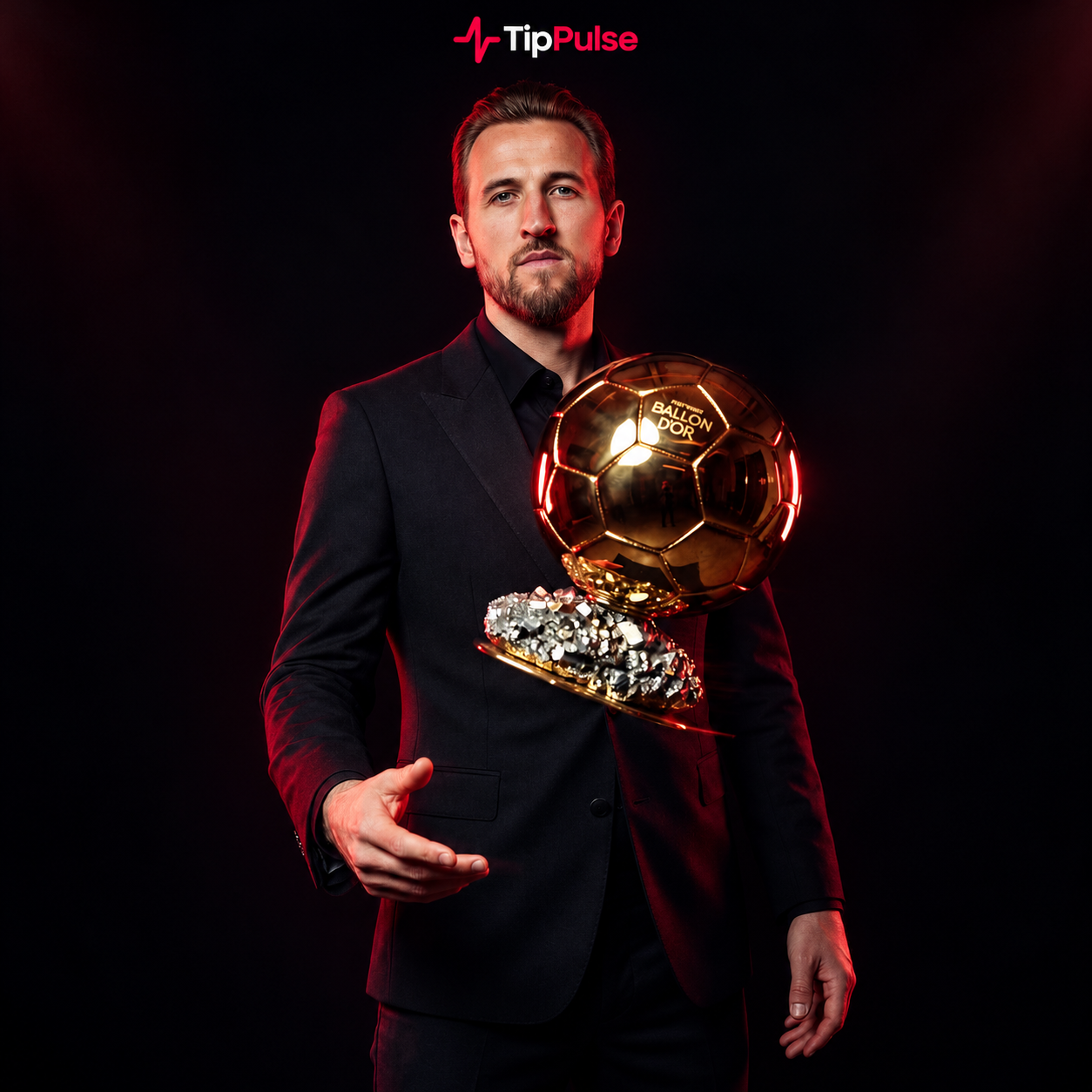
Harry Kane won the 2026 Ballon d’Or after combining extraordinary goalscoring with major domestic trophies and a productive World Cup. The Bayern Munich and England striker scored 73 goals in 65 appearances across the 2025/26 campaign, finishing ahead of Kylian Mbappé and Lamine Yamal.
His victory was announced in London on 26 October. It was his first Ballon d’Or and made him the first English winner since Michael Owen in 2001.
There was no single match that explained the award. Kane’s strongest argument was the accumulation of goals, consistency and decisive contributions across different competitions.
Published: 27 October 2026.
Harry Kane’s Ballon d’Or Season in Numbers
| Measure | 2025/26 record |
|---|---|
| Club and country appearances | 65 |
| Club and country goals | 73 |
| Club and country assists | 8 |
| Bayern appearances | 51 |
| Bayern goals | 61 |
| England goals across the campaign | 12 |
| Bundesliga goals | 36 |
| DFB-Pokal goals | 10 |
| Champions League goals | 14 |
| German Super Cup goals | 1 |
| 2026 World Cup goals | 6 |
The six World Cup goals are included in his England total, not added on top of it. Likewise, 73 represents his combined club-and-country output, while 61 is his Bayern total.
1. His Goalscoring Was Exceptional Even by Elite Standards
Kane averaged approximately 1.12 goals per appearance for club and country. At Bayern alone, his 61 goals in 51 matches worked out at almost 1.20 per appearance.
These are goals-per-appearance calculations, not per-90 statistics. Even with that distinction, they illustrate the scale of his production: he sustained a scoring rate above one goal per match across an entire campaign.
His Bundesliga contribution was equally substantial. With 36 league goals, he finished as the division’s leading scorer for a third consecutive season.
For his Ballon d’Or case, the significance was consistency. His output was spread across league football, domestic cup matches, Europe and international competition rather than concentrated in one tournament.
2. Bayern’s Trophies Gave His Numbers Collective Weight
Bayern won the Bundesliga, DFB-Pokal and German Super Cup during the campaign. The league-and-cup double was the centrepiece of that domestic success.
Individual output and team achievement reinforced each other. Kane was not simply scoring heavily while his club fell short everywhere; his goals accompanied silverware.
That does not make trophies an automatic measure of individual quality. It does, however, strengthen the argument when a player is both extraordinarily productive and directly influential in a winning team.
3. A Cup-Final Hat-Trick Supplied a Defining Moment
Kane scored all three goals in Bayern’s 3–0 DFB-Pokal final victory over Stuttgart.
He completed the hat-trick in one half, turning a major final into one of the clearest demonstrations of his finishing. His ten goals across the cup campaign also showed that the final was the culmination of sustained production.
In assessing his season, this performance matters because it connects volume with consequence. Three goals in a final directly decided a trophy rather than merely extending an already comfortable league scoreline.
4. He Delivered in Champions League Knockout Football
Bayern did not win the Champions League, but Kane scored 14 goals as they reached the semi-finals.
He finished behind Mbappé, who scored 15, in the competition’s scoring standings. Kane’s argument was therefore not that he led every individual category.
His particular achievement was scoring in six consecutive Champions League knockout matches, matching a sequence previously achieved by Cristiano Ronaldo.
That run gave his candidacy evidence beyond domestic dominance. He continued scoring when the opposition and the consequences became more demanding.
5. The World Cup Strengthened His International Case
Kane scored six times at the 2026 World Cup as England finished third, their best result in the tournament since winning it in 1966.
England did not become world champions, so his victory should not be explained through a title he did not win. Instead, his contribution added another major stage on which he produced.
The combination mattered: a prolific club season was followed by a significant scoring contribution during a deep international tournament run.
6. His Value Extended Beyond Finishing
TipPulse tactical analysis: Kane’s movement gives his teams more than a fixed target inside the penalty area.
When he drops towards midfield, a centre-back must decide whether to follow him. Following can open space for a winger’s diagonal run; staying back can allow Kane to receive, turn and connect the attack.
He can then arrive in the box after helping create the move. That combination of involvement and finishing makes him difficult to treat as a conventional penalty-area striker.
The eight assists recorded in his combined season add context, although an assist total alone cannot capture every useful lay-off, switch of play or movement that creates space.
Why Did Kane Finish Ahead of Mbappé and Yamal?
The official order placed Kane first, Mbappé second and Yamal third. The result does not mean Kane was superior in every aspect of football.
Rather, his overall case brought together several powerful elements: exceptional scoring volume, domestic silverware, decisive knockout performances and a strong World Cup contribution.
Without the full individual ballots and explanations, no report can establish precisely why every journalist preferred him. Those achievements explain the strength of his candidacy, rather than proving a single universal reason for the vote.
Ballon d’Or and Gerd Müller Trophy: Two Different Honours
Kane also received the Gerd Müller Trophy, recognising his goalscoring achievements.
The distinction matters. Winning the scoring award demonstrated his extraordinary output; winning the Ballon d’Or reflected the broader assessment of his season.
TipPulse Verdict
Kane’s 2026 Ballon d’Or was supported by a complete body of work: 73 goals, Bayern’s domestic trophies, a cup-final hat-trick, repeated Champions League knockout goals and six World Cup strikes.
He did not need to win every competition or lead every statistical category. His strongest claim was the combination of sustained excellence and decisive performances across the season.