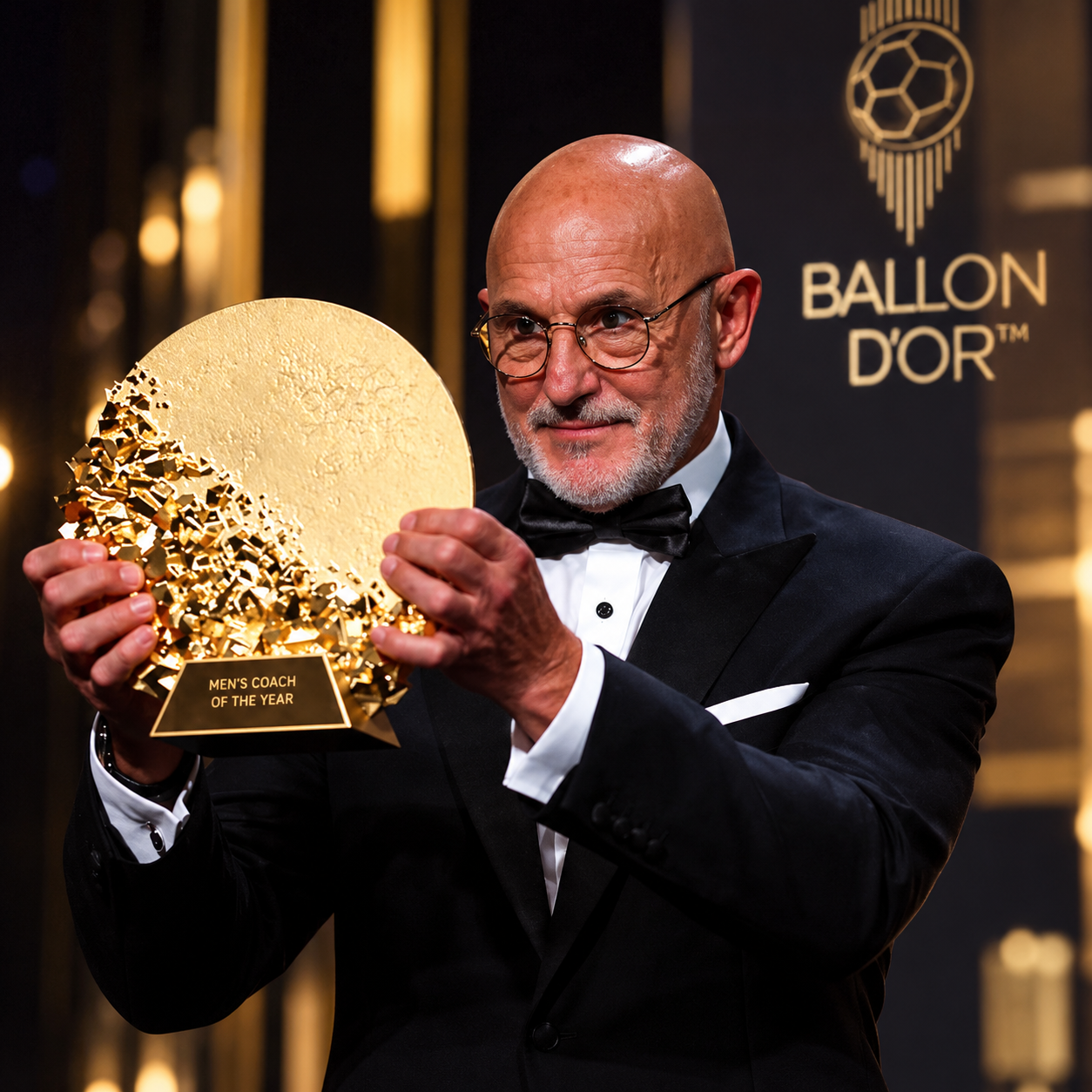
Luis de la Fuente has been officially crowned the best men’s coach in world football, winning the Men’s Coach of the Year award at the 2026 Ballon d’Or ceremony after guiding Spain to an historic FIFA World Cup triumph.
The Spain manager received the prestigious coaching honour following a remarkable year in which La Roja became world champions, broke the international record for consecutive unbeaten matches and established themselves as arguably the strongest national team in football.
De la Fuente beat a high-level group of coaching candidates that included Luis Enrique, Mikel Arteta, Unai Emery and Vincent Kompany.
But after Spain’s extraordinary 2026 campaign, his victory was difficult to argue against.
Why Did Luis de la Fuente Win?
The biggest reason was obvious: Spain won the 2026 FIFA World Cup.
De la Fuente’s side defeated Argentina 1-0 after extra time in the final, with Ferran Torres scoring the decisive goal in the 106th minute.
Spain’s road to the trophy was exceptionally impressive. They progressed from Group H before beating Austria 3-0, Portugal 1-0, Belgium 2-1 and France 2-0 in the knockout rounds, before shutting out Argentina in the final.
Across eight World Cup matches, Spain scored 14 goals and conceded only once.
That defensive record was historic. No men’s World Cup-winning team had ever conceded fewer goals during a single tournament, while goalkeeper Unai Simón recorded seven clean sheets.
A World Cup Built on Control and Balance
Spain were not simply a defensive team protecting narrow leads.
De la Fuente created a side capable of controlling possession, pressing aggressively and attacking through several different areas of the pitch.
Rodri provided control in midfield, Lamine Yamal offered one-on-one creativity from the right, while players such as Pedri, Fabián Ruiz, Nico Williams and Dani Olmo gave Spain different ways to progress and create chances.
The remarkable part was the balance.
Spain could dominate possession against teams that defended deep, but they could also slow matches down, protect a lead and survive high-pressure knockout situations.
That tactical flexibility became one of the biggest differences between De la Fuente’s Spain and some previous possession-heavy Spanish teams.
The Numbers Behind His Success
De la Fuente’s record with Spain has become exceptional.
According to the Spanish Football Federation, he has now overseen 54 senior international matches, recording 42 wins, 10 draws and only two defeats.
That works out at a win rate of approximately 78%.
His World Cup victory also arrived in his 50th match in charge, at which point he had already recorded 38 victories.
But perhaps the most remarkable number is Spain’s unbeaten run.
The World Cup final extended La Roja’s sequence to 38 consecutive matches without defeat, setting a new world record for a men’s senior national team.
The previous recognised record belonged to Italy, who went 37 matches unbeaten between 2018 and 2021.
Three Major Trophies With Spain
The World Cup was not an isolated achievement.
Since taking over the senior national team in December 2022, De la Fuente has built one of the most successful periods in Spain’s history.
His first major trophy came in the 2023 UEFA Nations League, when Spain defeated Croatia on penalties in the final.
One year later, Spain produced a perfect European Championship campaign and won UEFA EURO 2024, beating England in the final after winning all seven matches at the tournament.
Then came the biggest prize of all in 2026.
Nations League winner. European champion. World champion.
De la Fuente has now collected all three trophies during a remarkably short period as Spain manager.
From Spain’s Youth Teams to World Champion
Another major reason his story stands out is the path he took to the top.
De la Fuente was not appointed because of a superstar coaching reputation built at one of Europe’s richest clubs.
He spent years working inside Spain’s national-team structure, coaching several generations through the youth levels before eventually receiving the senior job.
That experience became an important advantage.
Several members of Spain’s current generation had already worked with him before reaching the senior team, allowing De la Fuente to build what he frequently describes as a “family” rather than simply assembling a collection of talented individuals.
The results suggest that philosophy has worked.
He Also Made World Cup History
De la Fuente added another individual record in the World Cup final.
At 65 years and 28 days old, he became the oldest coach ever to win the men’s FIFA World Cup.
He surpassed fellow Spaniard Vicente del Bosque, who was 59 when he guided Spain to their first World Cup title in 2010.
Sixteen years later, De la Fuente delivered the country’s second star.
Why He Beat the Other Candidates
The competition for the coaching award was strong.
Luis Enrique had another outstanding period with Paris Saint-Germain, while Mikel Arteta, Unai Emery and Vincent Kompany were also recognised for their work at club level.
But De la Fuente had something none of them could match: the World Cup.
Winning football’s biggest tournament while conceding only one goal, establishing a world-record unbeaten run and continuing a sequence of major international trophies gave the Spain coach an overwhelming case.
TipPulse Verdict
Luis de la Fuente’s Coach of the Year award was about far more than one final.
World Cup champion. European champion. Nations League winner. A 38-match unbeaten record. Around a 78% win rate with Spain. Only one goal conceded during the entire 2026 World Cup.
Those numbers explain why he finished ahead of some of the biggest names in European club football.
De la Fuente inherited a talented Spain squad, but talent alone does not produce this level of consistency.
He transformed that talent into a team capable of controlling matches, surviving difficult moments and winning almost every major competition it entered.
The 2026 Ballon d’Or coaching award therefore does not simply recognise a World Cup winner. It recognises the man behind one of the most dominant international teams of the modern era.